



Doctrines & Definitions Required For Understanding
- Doctrine of Man (Anthropology within Classical Calvinism) The doctrine of man is the branch of theology that studies what human beings are, how they were created, what happened in the Fall, how sin affects them, and how they relate to God, one another, and the rest of creation.
- Original Sin The Christian doctrine that humanity fell in Adam and that all human beings inherit a sinful nature and stand under the consequences of Adam’s transgression. Within Anthropological Calvinism, original sin is often discussed in connection with inheritance, descent, and ordinary generation.
- Traducianism Traducianism is the doctrine that parents propagate the whole person, body and soul, through ordinary generation. According to this view, a child’s soul is derived from his parents just as his body is derived from his parents.
- Creationism (of the Soul) Creationism is the doctrine that God directly creates each individual soul. While a child’s body is derived from his parents through ordinary generation, his soul is an immediate act of divine creation by God.
- Ordinary Generation The process by which parents produce children through natural reproduction. In theological discussions of traducianism, ordinary generation refers to the transmission of human nature from parents to children across successive generations.
- Common Descent The principle that individuals or groups share ancestry through descent from common ancestors.
- Natural Sciences The natural sciences are branches of knowledge that study the physical world through observation, measurement, testing, and evidence.
- Anthropology (Science) Anthropology is the study of human beings, both past and present. It examines human origins, biological variation, cultures, languages, societies, and historical development.
- Biological Anthropology Biological anthropology is a branch of anthropology that studies human biological variation, evolution, genetics, ancestry, adaptation, and relationships among human populations. It focuses on the physical and hereditary aspects of humanity.
- Kinship Studies (Kinship Patterns) A branch of anthropology that studies how human beings organize relationships through family, descent, ancestry, marriage, adoption, and social ties.
- Ethnology The branch of anthropology concerned with the study and classification of human peoples, cultures, ethnic groups, and societies.
- Taxonomy A taxonomy is a system used to identify, classify, organize, and describe things based on shared characteristics and relationships.
- Biological Systematics The branch of biology concerned with identifying, naming, and classifying organisms and determining their relationships to one another.
- Clade A clade is a group of organisms that share a common ancestor and all of that ancestor’s descendants.
- Cladistics Cladistics is a method of classification that organizes living things according to patterns of common ancestry and descent. Instead of focusing primarily on appearance, cladistics attempts to reconstruct relationships by determining which organisms share a common evolutionary history.
- Cladistic System A cladistic system is a classification system built upon the principles of cladistics.
- Hermeneutic A method for interpreting information, texts, events, or ideas. In theology, a hermeneutic is the interpretive lens through which Scripture and other religious concepts are understood.
- Anthropological Calvinism (Kinism) A form of Calvinist theology that places particular emphasis on the transmission of human nature through ordinary generation, inherited characteristics, common descent, and the continuity of peoples across generations. While retaining traditional Calvinist doctrines such as original sin, election, and divine sovereignty, it interprets many theological categories through the lens of anthropology, lineage, inheritance, and peoplehood. [To clarify, this is a term I have created to distinguish what practitioners of Kinism believe from what is generally understood as Classical Calvinism. Because additional categories are introduced into the system, those categories often produce noticeable shifts in other doctrines. Kinists themselves would not necessarily see themselves as distinct from Classical Calvinism; while some would argue that they are practicing a more historically consistent form of Calvinism than many contemporary Calvinists and are distinct.]
- Race Realism A doctrine within Anthropological Calvinism that describes what human groups are.
- Kinism doctrine within Anthropological Calvinism that describes how human groups should live.
- Kinist Taxonomy (Race Realism Plus Kinism) Kinist Taxonomy is a classification system that organizes human beings according to relationships of descent, ancestry, lineage, kinship, ethnicity, peoplehood, nationhood, and race, and derives social and moral obligations from those classifications. The system consists of two interconnected components: Race Realism and Kinism. Functionally, however, both Race Realism and Kinism are situated and treated as doctrines within Anthropological Calvinism.
- [To clarify, this is a term I am using to make clear that Race Realism and Kinism are two parts of one whole. It is not a term used by Kinists themselves.]
- Normative Normative refers to statements about what ought to be, rather than simply what is. A normative claim attempts to establish standards, obligations, duties, or proper forms of behavior.
- Prescriptive System A prescriptive system goes beyond classification and description. It uses classifications to derive rules, duties, obligations, or norms regarding how individuals or groups should behave.
- Naturalistic Fallacy The naturalistic fallacy is the error of concluding that because something exists in nature, it is therefore morally good, right, or how people ought to behave.
What They Say Kinism Means
“Kinism is the belief that ordained social order for man is tribal & ethnic rather than imperial & universal. Mankind was designed by God to live in extended family groups. Blood ties are the only workable basis for a healthy society not subject to the ideologies of fallen man” (McAtee, 2025).
What It Actually Means
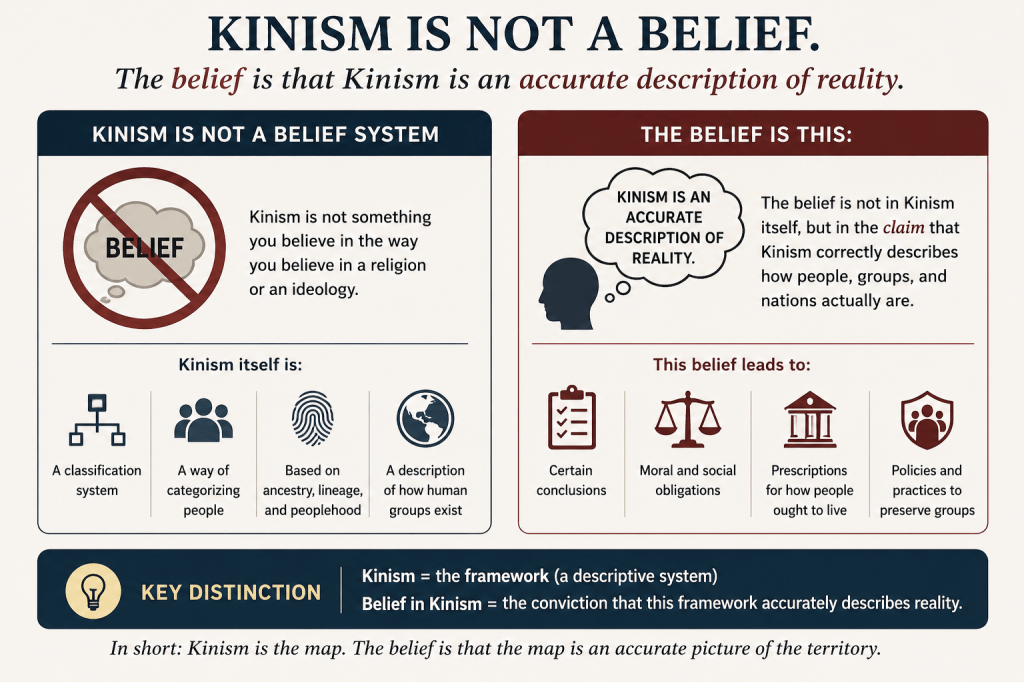
Depending upon who is giving the definition, the phrase “Kinism is the belief that…” can be misleading. It suggests that Kinism is a personal preference, ideological commitment, or voluntary opinion. It is not a belief in the same sense as saying, “We believe tribes should exist,” “I prefer tribal societies,” or “I have chosen to believe these propositions are true.”
A kinist would generally argue that Kinism is not just a belief about society but a description of the structure of human relationships and social order. One can believe gravity exists, but gravity itself is not a belief. Gravity is a description of reality. Likewise, a kinist would argue that Kinism describes realities such as family, ancestry, ethnicity, peoplehood, and nationhood and the relationships between them. The belief is not Kinism itself; the belief is that Kinism accurately describes reality.
For that reason, the use of the word “belief” can imply a degree of personal choice that many advocates would reject. They would be more likely to frame their position not as “I have chosen to believe this,” but as “I recognize this to be true.” Whether that recognition is correct is a separate question, but from within the system Kinism is presented as a description of reality from which social and moral conclusions are derived rather than as a preference among competing social arrangements.
Strictly speaking, the belief is not Kinism itself. The belief is that Kinism accurately describes reality. Kinism is called Kinism because it draws upon concepts of kinship, descent, and ancestry studied in anthropology, ethnology, and kinship studies.
This distinction matters because disagreements often occur at different levels of the discussion. Critics frequently treat Kinism as a political preference or ideological commitment. Advocates frequently treat Kinism as a description of reality. Each side may believe it is addressing the other’s position while actually discussing something different. One side is debating the desirability of the conclusions, while the other is defending what it regards as an accurate description of the world from which those conclusions follow.
The definition they use for Kinism is a simplified paraphrase that actually tells you its function within a classification system. It is more of a summary of a conclusion rather than a definition. In this sense, the “definition” is not really explaining the underlying structure. It is describing the function of Kinism after the structure is already assumed.
The statement tells you what Kinism concludes: society should be organized around kinship, blood relationships are foundational, tribal and ethnic bonds are normative, and social obligations arise from those relationships.
But it does not tell you how those conclusions are reached. Instead, what this definition represents is the conclusion of a larger process, a classification system that identifies and organizes human groups. Kinism takes those classifications and derives social and moral obligations from them.
Kinist Taxonomy
Kinism and Race Realism combined is a biological anthropological taxonomy, a kinship pattern and a cladistic system that became a prescriptive doctrine within Anthropological Calvinism. Kinship patterns are a branch of anthropology that studies how humans organize relationships through family, descent, ancestry, and kinship (Saneda, 2025). Cladistics are a method within biological systematics that classifies organisms according to common ancestry and descent (University of California Museum of Paleontology, 2026).
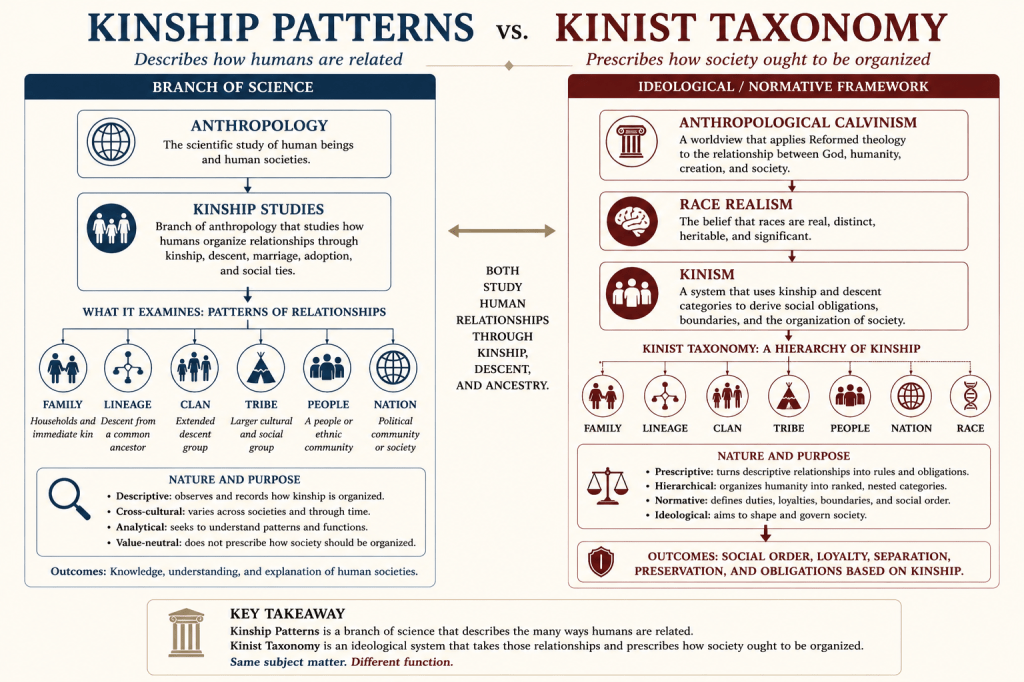
Race Realism asks the question of what human groups are and begins the process of classification. Kinism then takes those classifications and derives moral obligations from them. Race Realism identifies the groups; Kinism prescribes how those groups should live and relate to one another.
Together they form a classification system that organizes humanity according to ancestry, descent, and peoplehood, while prescribing how those groups should live and relate to one another.
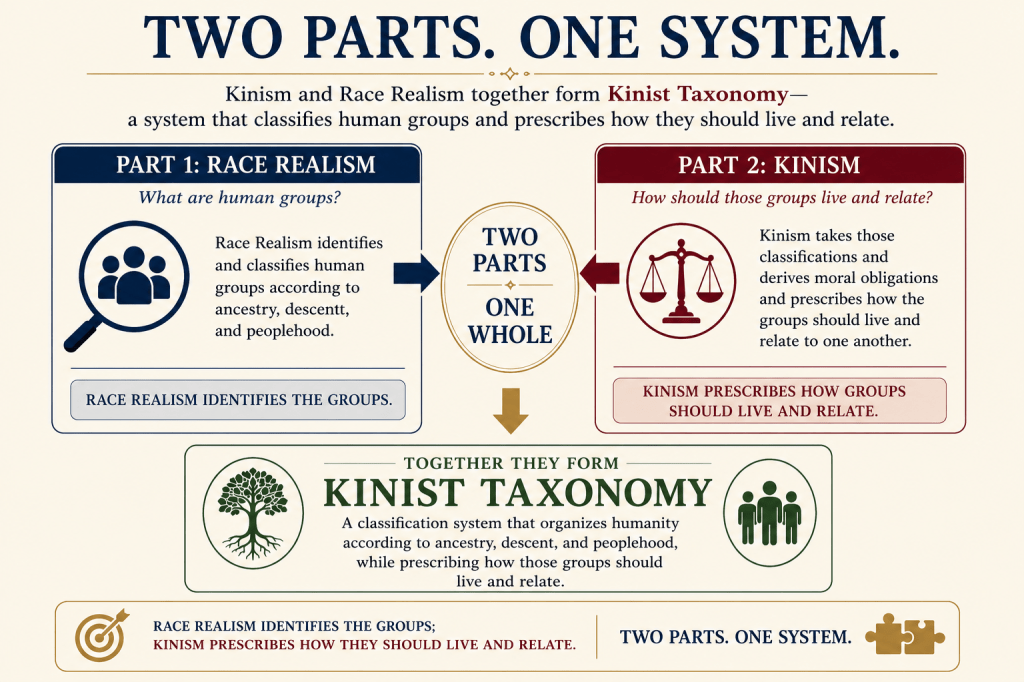
Unfortunately, they are not explained as such in a way that is easy to understand for outsiders. Currently, at the time of this writing it is difficult to see that the two are parts of a whole. For the sake of simplicity here, the system in its entirety will be referred to as Kinist Taxonomy.
Kinist Taxonomy is the classification system that answers the questions of what people groups are and of how human beings should live and organize themselves within their kin groups and what moral obligations those relationships imply. It combines multiple systems of classification and then treats the resulting hierarchy as a reflection of divine order.
Traditional Taxonomies
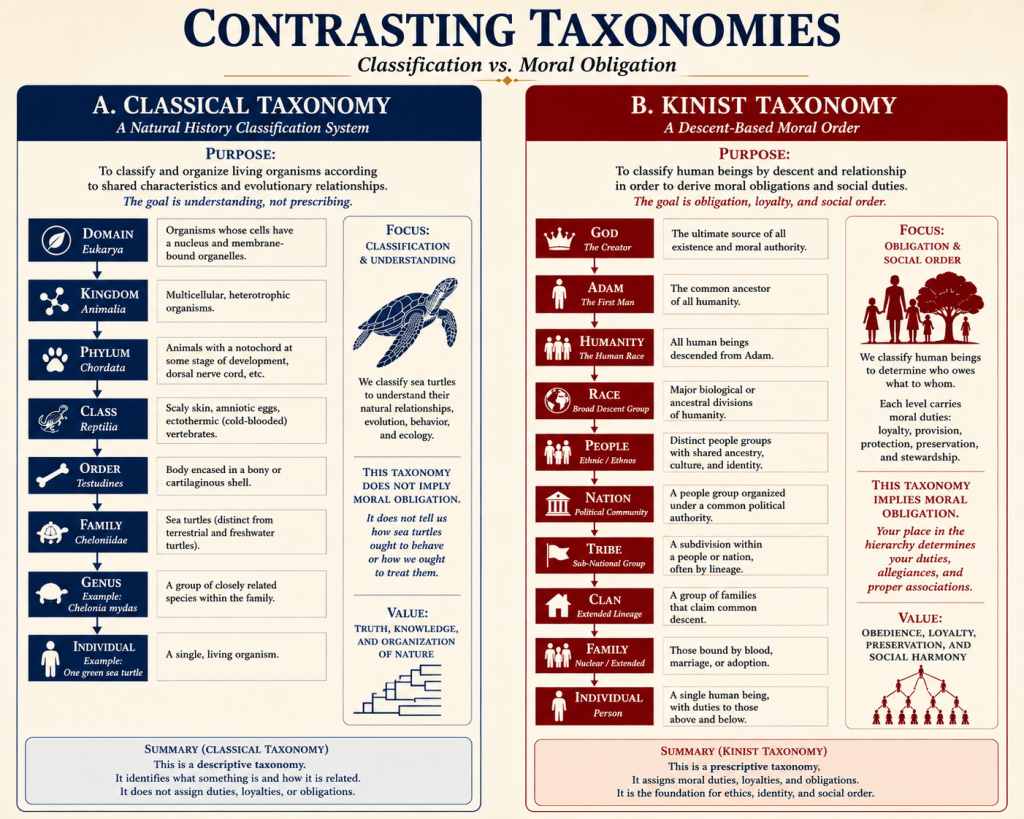
While traditional taxonomies seek to classify and describe relationships, Kinist Taxonomy derives moral obligations from those classifications. The hierarchy itself becomes normative, serving as the foundation for social ethics, human association, and theories of proper social order.
A classification system is a human tool used to organize and describe reality. Kinism treats these categories differently. Instead of viewing them as descriptive tools for understanding ancestry, descent, and peoplehood, it treats them as revealing the structure of God’s intended social order.
Family, clan, tribe, people, nation, and race become more than classifications. They are understood as categories carrying moral significance. The hierarchy is assumed to identify the proper ordering of society, the proper objects of loyalty, and the proper boundaries of association. Duties of stewardship, preservation, care, and allegiance are then derived from the structure itself.
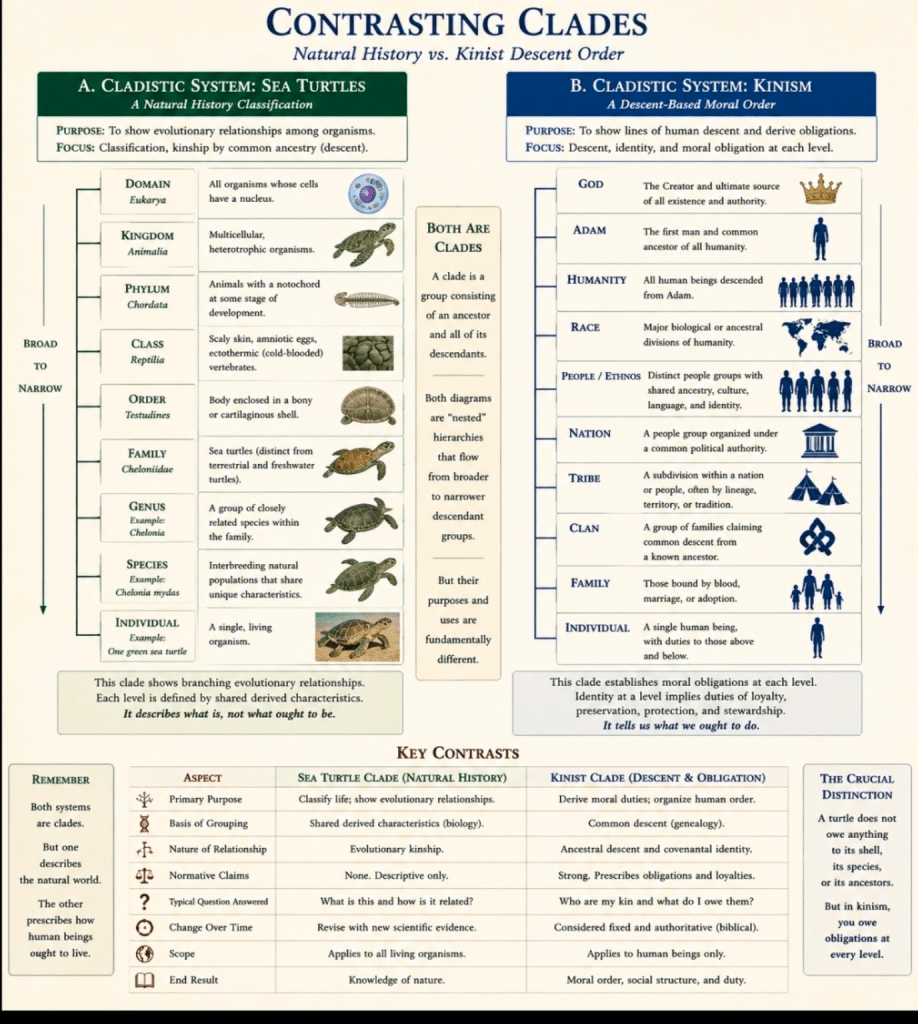
What begins as a system for organizing human relationships becomes a blueprint for social order, moral obligation, and human association.
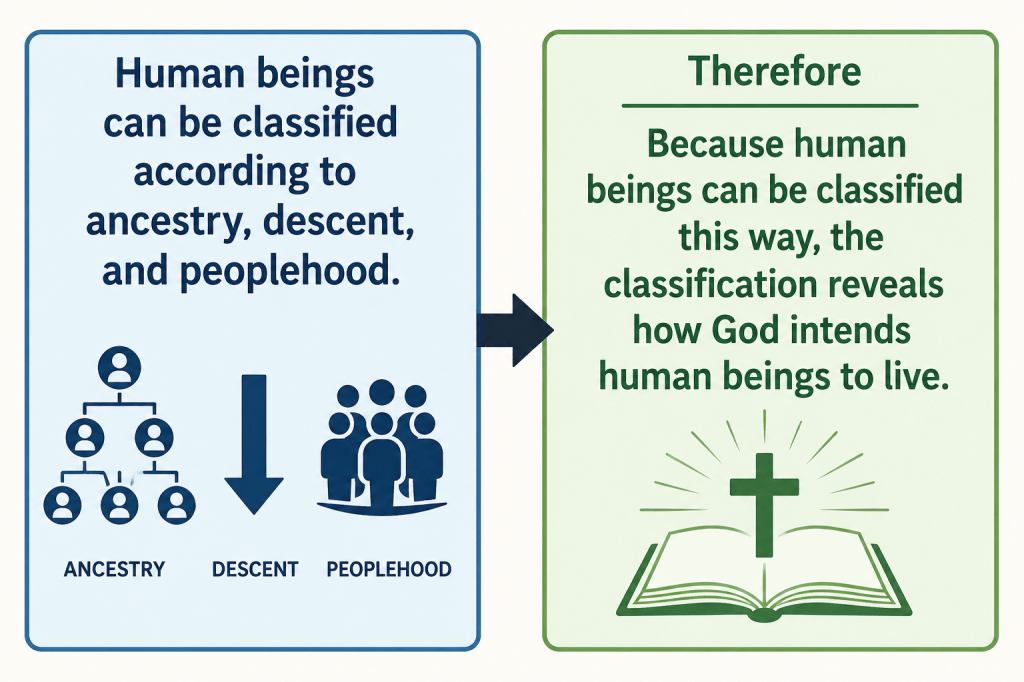
Kinist Taxonomy in Practice
Kinism taxonomy is often presented as the belief that distinct peoples should be preserved. In practice, it functions as a hermeneutic by which many other Christian duties are understood. Questions involving family, church, charity, marriage, politics, immigration, culture, and social order are interpreted through kinship and common descent.
Within Anthropological Calvinism, God created humanity in Adam while also providentially forming and preserving distinct peoples throughout history. Both the universal family of mankind and particular ancestral groups are therefore regarded as real features of the created order.
The definition of kin extends beyond immediate and extended family relationships. Ethnicity, peoplehood, nation, and race are understood as larger forms of kinship connected through ancestry and inheritance. Families expand into peoples, peoples into nations, and nations into races.
Because these groups are viewed as extended kin groups, duties associated with family relationships are extended outward as well. Loyalty, association, stewardship, care, and preservation apply not only to family members but also to one’s people, nation, and race. Maintaining these groups and their distinct identities is therefore regarded as a positive good.
The Development of Kinist Taxonomy
Kinist Taxonomy arises from a series of theological conclusions about human nature, inheritance, and peoplehood. Human beings are understood to descend from Adam through ordinary generation, with inherited characteristics persisting through lineage and ancestry, including sin nature.
Because humanity is understood as continuing through generations, families naturally expand into larger groups. These groups are regarded as real features of creation rather than temporary social arrangements.
God is also understood to have formed, ordered, and preserved distinct peoples throughout history. As a result, duties normally associated with family relationships extended to larger groups connected by common descent, particularly preservation.
Historic Sources for Kinist Taxonomy
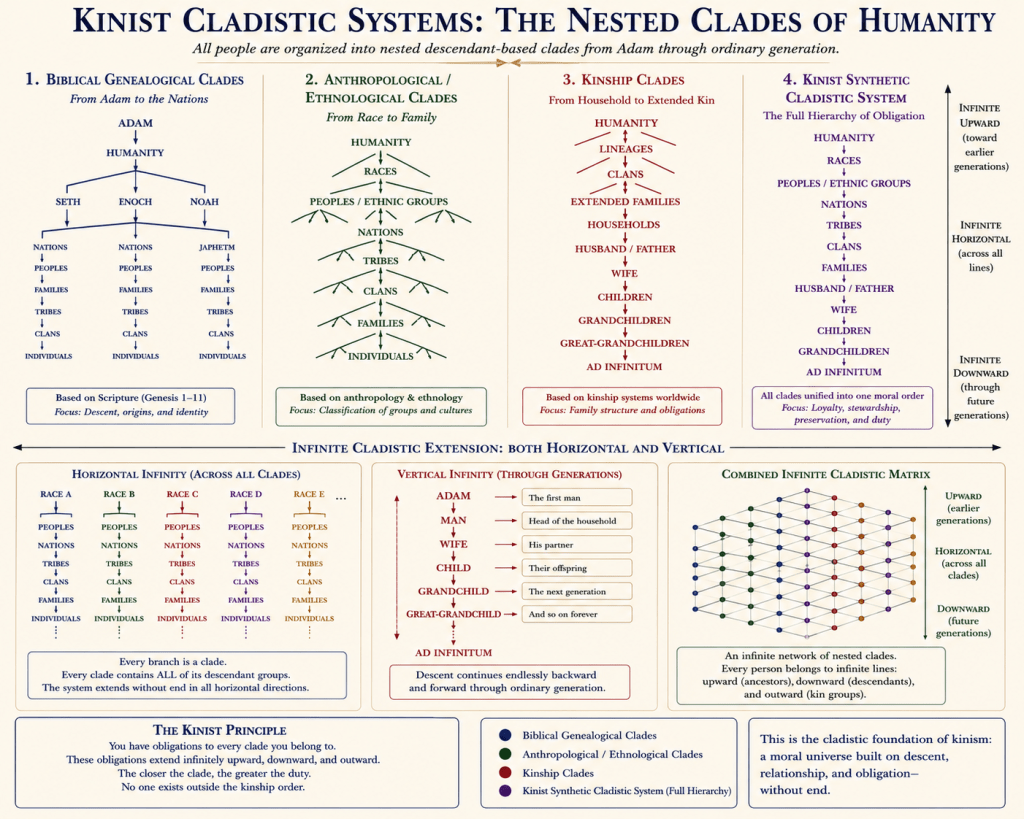
Historically, Kinist Taxonomy draws upon both biblical genealogies and later theories of descent and peoplehood. Humanity is understood through nested kinship groups extending from Adam to families, clans, peoples, nations, and races. This resembles the classificatory systems developed in ethnology, anthropology, natural history, and biblical race theory, all of which sought to organize humanity according to ancestry, lineage, inheritance, and common descent.
Kinism belongs to a long tradition of attempts to classify humanity through ancestry and descent. The earliest example is the Table of Nations in Genesis 10, which organized the peoples of the world through Noah and his descendants. Later Christian writers attempted to connect contemporary peoples to these biblical genealogies.
During the seventeenth and eighteenth centuries, developed increasingly detailed systems of biblical ethnology. In the late eighteenth century, members of the Göttingen School classified peoples according to ancestry, language, history, nationhood, and developed early racial classifications.
Throughout the nineteenth century, natural sciences became more prominent and anthropologists increasingly organized humanity according to ancestry, lineage, nationhood, race, and inherited characteristics. Across these systems, the central task generally sought to classify humanity into groups connected by common descent and inherited identity. Anthropologists have long recognized that kinship systems can be organized into nested descent groups extending from lineages and clans to larger social structures based upon common ancestry (Saneda, 2025).
Kinist Taxonomy follows this same pattern but takes an additional step. Within Anthropological Calvinism, humanity is understood through nested descent groups extending from Adam to families, clans, peoples, nations, and races. Borrowing from traducianism, souls are created by parents and original sin is biologically inherited. In this way, Kinism transforms a system of classification into a doctrine of social ethics. The question is no longer only how humanity is organized, but how those groups should live and relate to one another according to the hierarchy discovered by using Kinist Taxonomy.
Part of the difficulty in defining Kinist Taxonomy is that it combines several different systems of classification. Biblical genealogy traces descent through individuals and families from Adam to Noah and then to the descendants of Shem, Ham, and Japheth. Ethnology classifies humanity according to ancestry, language, culture, peoplehood, nationhood, and race. Taxonomic and cladistic systems organize living things into nested groups based on common ancestry and descent.
Within Kinist Taxonomy, these systems are merged into a single hierarchy that is then replicated throughout other biblical topics.
How They Percieve It
Practitioners of Anthropological Calvinism frequently discuss ancestry, lineage, inheritance, peoplehood, nationhood, and race because these are categories within the same classification system. The movement continually returns to these topics because they are constantly being defined, defended, and applied. They are often most hostile when discussing categories within this system. They frequently attack people they perceive as being outside the order they have constructed. They are much less hostile when discussing topics outside of Kinist Taxonomy. To them, it is not a human made classification system with moral obligations attached to it. It is the order in which God ordained humanity to live.
As a result, they believe they are defending God’s order when they are actually defending a taxonomy that has been elevated into a doctrine of social order and moral obligation.
See The Mechanism
Once Kinism is understood as part of a classification system, these recurring discussions become easier to recognize. The focus is not on any single category. The focus is on maintaining the system from which its ethical conclusions are drawn.
Imagine a librarian who constantly talks about genres, authors, call numbers, and shelving systems. An outsider might conclude that the librarian is obsessed with call numbers. In reality, the call numbers matter because they are part of the system used to organize the library.
The same principle applies to Kinist Taxonomy. Outsiders often assume that kinists are primarily concerned with race. From within the system, however, race is only one category among many. Ancestry, lineage, inheritance, ethnicity, peoplehood, nationhood, and race function as the organizing categories through which humanity is understood. The repeated discussion of these topics reflects the importance of the classification system itself.
Understanding Kinist Taxonomy as a structure makes it easier to identify, resist, and evaluate. When attention is focused only on race, ethnicity, nationalism, immigration, or cultural preservation, the larger system remains hidden. Once the underlying structure is visible, the pattern becomes easier to recognize.
This also helps explain how people are drawn into the system. Most are not introduced to the entire taxonomy at once. Instead, they encounter ideas such as family loyalty, cultural continuity, national identity, or concern for ancestry. Viewed individually, these ideas may seem reasonable. The larger structure connecting them often remains unseen.
Recognizing the structure also improves debate. Discussions frequently focus on individual conclusions while leaving the structures and theologies that produced them untouched. If one category is challenged, the argument can simply move to another category within the same system. By examining the classification structure itself, the discussion shifts to the assumptions that connect ancestry, peoplehood, and kinship to moral obligation. Rather than debating one conclusion at a time, it becomes possible to examine the framework that generates them all.
Not All Practitioners Are Equal in Understanding
It is important to recognize that the terminology within Kinist Taxonomy, and by extension Anthropological Calvinism, is academic in nature. Many of the underlying concepts involve older theological, anthropological, and philosophical arguments that would generally require advanced education to fully articulate and understand.
At the same time, America is experiencing a functional literacy crisis. In the US 21% of adults were illiterate in 2024, 54% of adults read below a 6th-grade reading level, 20% read below a 5th-grade level (National Literacy Institute, 2025). Many people can comfortably read ordinary books and articles but struggle with technical writing, especially when discussing abstract concepts and specialized academic categories.
As a result, many within the movement know little or nothing about topics such as Traducianism, ethnology, or systems of classification, yet they still agree with the conclusions reached by those in authority. They may know the conclusion without knowing the chain of reasoning that produced it.
Recognize Paraphrase, Analogies, and Slogans Replacing Theology
Leaders within the movement are often trained pastors. Part of the role of a pastor is to communicate complex theological concepts in simplified ways that can be understood by ordinary church members. Their primary goal is usually not to provide a comprehensive academic education on every subject but to communicate conclusions, doctrines, and applications that can be readily understood and adopted by a congregation with mixed levels of understanding.
By contrast, academics and educators are generally concerned with developing a deeper understanding of a subject. They often seek to explain the historical development of an idea, competing viewpoints, technical terminology, underlying assumptions, and the chain of reasoning that leads to particular conclusions.
A pastor is still an educator, but not in the same sense that a professor is an educator. Understanding theology is not a requirement for salvation, whereas mastery of a subject within an academic setting is generally required for graduation. Therefore, instruction differs between the two professions.
As a result, many people within the movement may be familiar with conclusions while remaining unfamiliar with the technical concepts from which those conclusions are derived. They may strongly affirm doctrines involving ancestry, peoplehood, inheritance, preservation, or kinship without possessing detailed knowledge of subjects such as Traducianism, ethnology, common descent, or systems of classification.
This distinction helps explain why outsiders who attempt to trace the origins and development of these ideas often encounter resistance, simplified definitions, paraphrases, analogies, and slogans.
Conclusion
Overwhelmingly, the response to Kinism appearing within churches has been to confront the racist rhetoric expressed by members of the movement in online forums, articles, podcasts, and social media. This should be done and is commendable. Churches have a responsibility to oppose sinful attitudes and behaviors wherever they appear.
The difficulty arises when conclusions observed in the behavior of adherents, or in their agreement with other ideologies centered on racial superiority, are incorporated into the definitions of Race Realism and Kinism themselves.
In practice, many critics begin with the conclusions they observe and then work backward. If individuals who identify as Kinists frequently express racial animosity, advocate racial superiority, or associate with explicitly racist movements, critics may conclude that these ideas are intrinsic to the definitions of Kinism and Race Realism. As a result, the observed behavior becomes the definition.
In fairness, Kinists themselves often do not articulate their beliefs very well, particularly in online environments. They are not always aware of the logic and assumptions that underlie the system they have adopted when asked direct questions.
The purpose of identifying and describing the structure of Kinist Taxonomy should not be criticism alone. Earlier detection, prevention, and redemption are the ultimate goals.
By the time overt racial hostility or separatism becomes visible, many of the underlying assumptions have already been accepted. Understanding the system makes it possible to recognize those assumptions earlier and address them before they develop further.
For that reason, the goal here is not simply to condemn conclusions, but to understand the system that produces them. Earlier recognition creates opportunities for prevention, correction, and ultimately redemption.
References
McAtee, B. (2025, July 25). A simple definition of kinism offered and defended (No. 91) [Audio podcast episode]. In Iron Rhetoric with Pastor Bret McAtee. Pactum Institute. https://www.pactuminstitute.com/podcasts-videos/iron-rhetoric-ep-88-a-simple-definition-of-kinism-oferred-and-defended
Saneda, C. (2025). 2.3: Kinship. In Cultural anthropology. LibreTexts Social Sciences. Retrieved June 5, 2026, from https://socialsci.libretexts.org/Bookshelves/Anthropology/Cultural_Anthropology/Cultural_Anthropology_(Saneda)/02%3A_Social_Institutions/2.03%3A_Kinship
National Literacy Institute. (2025). 2024–2025 literacy statistics. https://www.thenationalliteracyinstitute.com/2024-2025-literacy-statistics

